ChatGPT for Real Estate: What the Viral Florida Home Sale Story Got Wrong

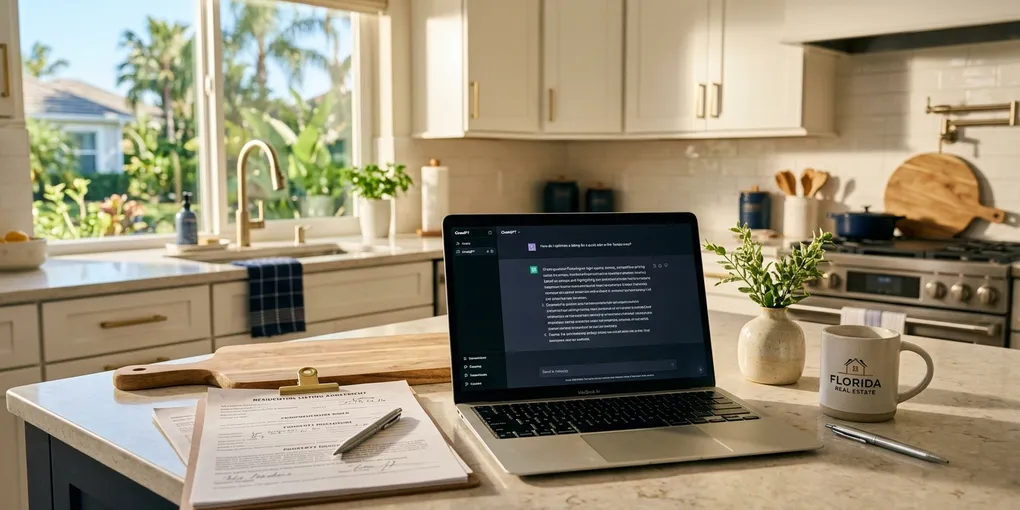
Fortune Magazine: “A man let ChatGPT sell his home. It beat every agent’s estimate by $100,000 and closed in 5 days.”
Newsweek: “Florida man used ChatGPT to sell his home for $100,000 more.”
30 million people saw these headlines across social media. It became the biggest ChatGPT for real estate story of the year. Every broker on LinkedIn shared it. Comments filled up with “agents are done” and “why would anyone pay 6%?”
Nobody checked the MLS.
I did. And the actual closing data tells a completely different story than the headlines. Credit to Lucas Mendicelli at The Real Frame for pulling the records first — what he found matters far more for your business than the panic or dismissal you’re probably seeing from other agents right now.
What the Viral Story Claimed
The narrative was clean and scary: a Florida homeowner named Robert Lavine used ChatGPT to sell his house. No agent. AI handled everything. The home sold for $954,000, $100,000 over what agents estimated, in just five days on market.
Here’s what the seller actually said, buried underneath the viral headlines: “When we met with the real estate agents, they lacked the confidence in pricing. ChatGPT gave us more confidence in price points of where the market was going.” And then this: “It doesn’t necessarily replace professionals, but it does allow us to have the ability to be more curious and feel more confident in the decisions we’re making.”
That’s a very different statement than “AI replaced my agent.” But nuance doesn’t get 30 million views.
What the MLS Actually Shows
When you pull the actual closing data — which nobody sharing the story bothered to do — two facts stand out:
A buyer’s agent was involved and compensated. A licensed real estate professional represented the buyer and earned a commission at closing. This was not a zero-agent transaction.
A licensed professional handled the sell side. The seller worked with Steven Koleno through BCOM Brokerage, a flat fee listing company. ChatGPT didn’t list the home, market the home, handle showings, or negotiate the deal. ChatGPT recommended the flat fee model, and a licensed broker executed it.
Koleno isn’t some random agent. He’s the managing broker for six firms across 15 states. He was the number three agent in the US in 2021 by transaction volume — 1,643 sales that year alone, over 12,000 total transactions. His operation is so well documented and consistently executed across those six brokerages that when a stranger in Florida asked ChatGPT for help, the AI recommended him.
As Koleno himself confirmed: “The viral version isn’t exactly how it played out. It’s been a while watching some of the big news go viral and it’s missing so much context.”
The Story vs. the Facts
Here’s the quick comparison:
The viral version: ChatGPT replaced the agent. AI made realtors obsolete. A pure FSBO with no professionals involved.
What actually happened: A buyer’s agent was compensated. A licensed professional handled the sell side through a flat fee model. ChatGPT recommended the flat fee model — it didn’t handle the sales process. And AI recommended this specific agent because of his documented infrastructure and track record.
ChatGPT didn’t replace the agent. It recommended one.
Can ChatGPT Replace Real Estate Agents? Both Camps Missed the Point
Every agent on LinkedIn fell into one of two camps. Camp one: panic. AI is replacing us, this is the beginning of the end. Camp two: dismissal. This is a one-off fluke, he got lucky, wait until he gets sued.
Both camps missed the point.
The real story is that a motivated seller’s first instinct was to ask AI for help with the biggest financial transaction of his life. And AI gave him a specific, actionable recommendation based on publicly available data. That’s the shift worth paying attention to.
AI is already routing consumers toward agents with the strongest documented value proposition. The fearful version of this story is “AI is coming for agents.” The accurate version is that AI is sorting agents by who has the most visible, verifiable track record — and sending business accordingly.
How ChatGPT Connected the Dots
The seller asked a simple question: “What is the best way to sell my home?”
ChatGPT synthesized everything publicly available — and that’s the key phrase, publicly available. AI trains on data it can access: Google reviews, Zillow reviews, Realtor.com reviews, transaction records, brokerage data, content, blog posts, social media presence.
It returned the most efficient path: a flat fee listing service through BCOM Brokerage. That path ran through Koleno’s infrastructure because he had 12,000 transactions and documented proof of results. ChatGPT recommended him through logic, not luck. If you want to understand which AI tools are actually worth using in your practice, I maintain a comprehensive comparison guide that’s updated regularly.
Why AI for Realtors Is Really About Your Digital Footprint
This is the part every agent needs to internalize. AI tools are reading your digital footprint right now. They’re pulling from:
- Google and Zillow reviews — quantity, quality, and recency all factor in
- Listing results — days on market, sale-to-list ratio, photo quality
- Content you create — blog posts, YouTube videos, social media, market reports
- Transaction history — are you documenting and sharing your results?
- Website and SEO — are you writing articles targeting specific keywords like “best realtor in [your city] for [your specialty]”?
YouTube is becoming especially important. AI platforms are increasingly training on video content, which means the videos you make today become the training data that shapes whether AI recommends you tomorrow.
If a motivated seller in your market typed “I’m getting divorced, who is the best real estate agent in [your city]?” into ChatGPT right now — would it recommend you? If you have a specific niche and documented results in that niche, the answer might be yes. If your online presence is thin, it’s recommending someone else.
Four Things to Do This Week
1. Ask ChatGPT about yourself. Open a fresh chat and ask: “Who is the best real estate agent in [your city] for [your specialty]?” See what comes back. Check why it recommended those agents. Look at the sources it cites. This gives you your baseline.
2. Build evidence AI can read. Be specific and public about your process. Document your sales process, your listing strategy, your buyer workflow — step by step. Write about it. Make videos about it. Put it in blog posts, short-form video, YouTube descriptions. AI trains on what’s publicly available. If you haven’t published it, AI doesn’t know about it.
3. Create content consistently. YouTube, Instagram, Facebook, blogs, market reports — AI reads all of it. Consistency matters more than perfection. The agents who show up in AI recommendations aren’t necessarily the best marketers. They’re the ones who’ve created enough documented evidence that AI can evaluate them.
4. Fix your listing data. Bad photos and high days on market become part of your AI training data. As AI starts ranking agents by performance metrics, the quality of your listings directly impacts your discoverability. Think about every listing as a data point that’s training AI’s opinion of you.
If you want a weekly breakdown of AI tools, prompts, and workflows tested in a real practice, subscribe to the newsletter.
The Bigger Picture
AI will not replace agents. It will divide them. The best agents — the ones with documented results, consistent content, and strong digital presence — will get recommended more. The 80% who don’t build that infrastructure will become increasingly interchangeable.
If you’re already at the top of your field but don’t have a social media presence, start building your credibility through blog posts, reviews, and content. You have the results — you just need to make them visible.
If you’re newer and want to compete, build your business around creating content, getting reviews, and documenting everything you do. I always recommend niching down — take over a specific market segment so you can build a track record AI can find, then expand from there.
The agent who built a system so well documented that AI recommended him to a stranger in Florida didn’t do it by accident. He built infrastructure. That’s not a threat — it’s a new bar for discoverability.
If you want to start building your AI-optimized presence, subscribe to the newsletter for my AI Listing Toolkit that audits your digital footprint and includes 7 copy-paste prompts for pricing analysis, marketing plans, and listing descriptions. And if you want weekly AI prompts and workflows for your practice, the newsletter is your best resource. I also track stories like this one as they break, most recently in Douglas Elliman building an AI data company.

Liked this article? Get more like it.
Real AI experiments, practical tutorials, and workflows you can use the same day. Free, unsubscribe anytime.